Eiko: Our last day of touring ended with our trip to the Memorial Peace Museum and Park in Hiroshima. We started the day with a meeting and I wanted to give some context and personal view to the group as we ranged in age from 13 and up, some whom had not yet taken world history, or others who needed a refresher.
The museum opened in 1955, and was updated in 2017 and 2019. The goal of the museum is to promote peace in the hope that history will not be repeated. The museum displays artifacts that remain from the atomic bombing and what happened when one bomb was dropped on this city.
I went through this exhibit when I was 13 years old traveling with the Emanuel Ringers in 1986 to attend the 2nd International Handbell Symposium. I was saddened/horrified/conflicted by what happened to the Japanese people by the Americans dropping the atomic bomb, which killed many people and for generations continued to affect people.
Being Japanese and American, it was like I had done this to myself. The devastation caused by the bomb were human beings doing this to other human beings.
I did not want the ringers to feel a sense of guilt, but to understand that we can not change what was in the past but do our best not to repeat it. There is hope that by understanding the effects of what a nuclear bomb is capable of, we can continue to be the ones to strive for peace.
The ringers already contribute to peace through music.
Back in 1986, when I was part of the Emanuel Ringers, we gave a concert at a nursing home for those who were affected by the radiation poisoning. The residents did not speak English and the choir did not speak Japanese. For me, back then, it was the first time that I understood the power of music and how music can be a common language. We played the famous Japanese tune, Sakura. As we rang, the residents began to hum with us. That is the power of music.
The participation of the ringers this coming week at the symposium, began back in 1982 when Mrs. Shin of Handbell Ringers of Japan and David Davidson of AGEHR, American Guild of English Handbell Ringers, (now HMA, Handbell Musicians of America), decided to create the International Handbell Symposium. Bringing people together through music, we can show how we are more alike than we are different.
Peace through music.
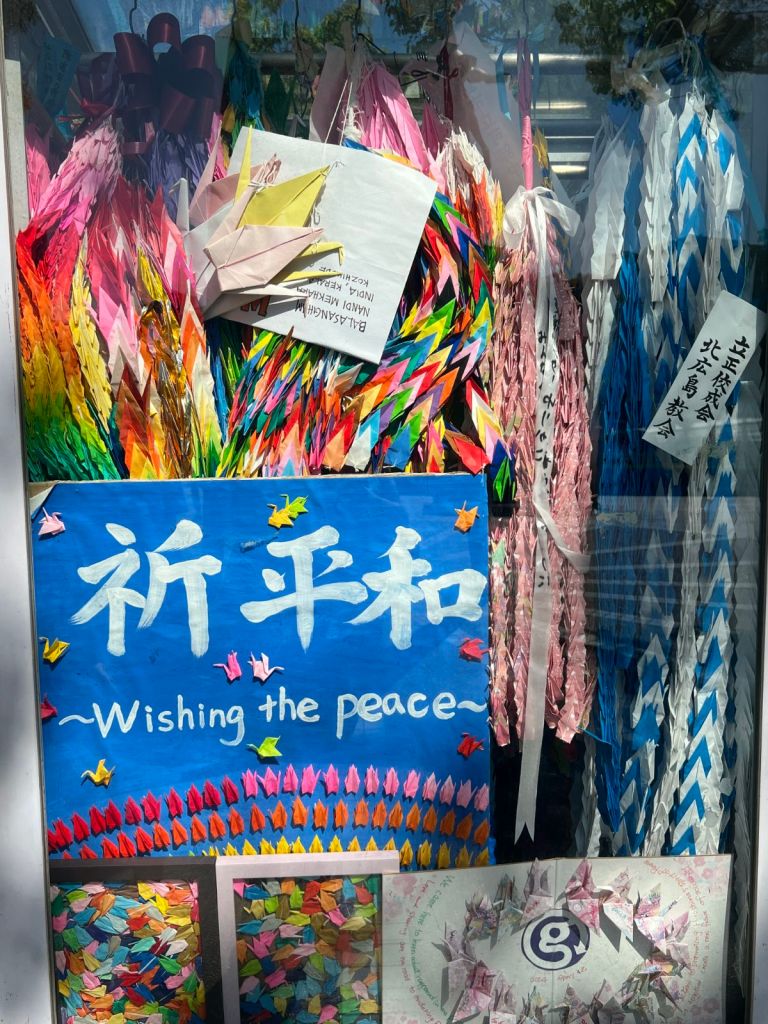
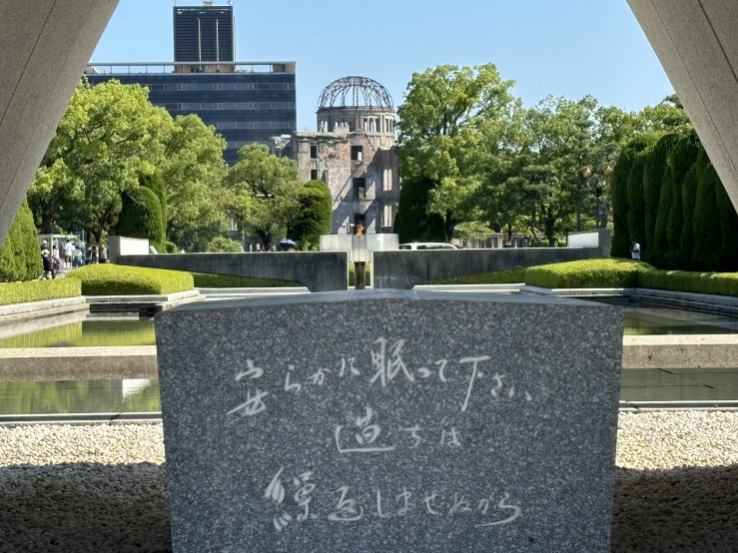
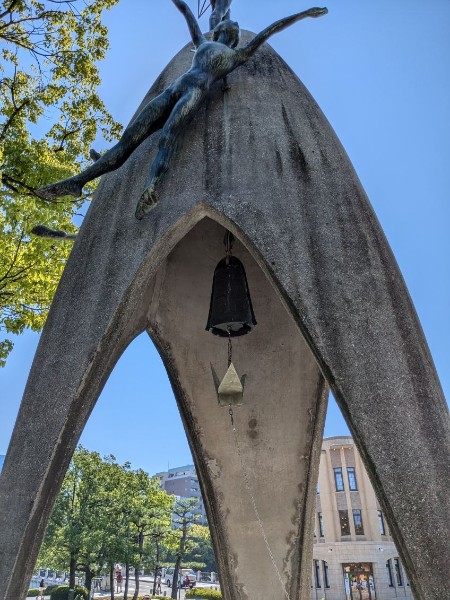
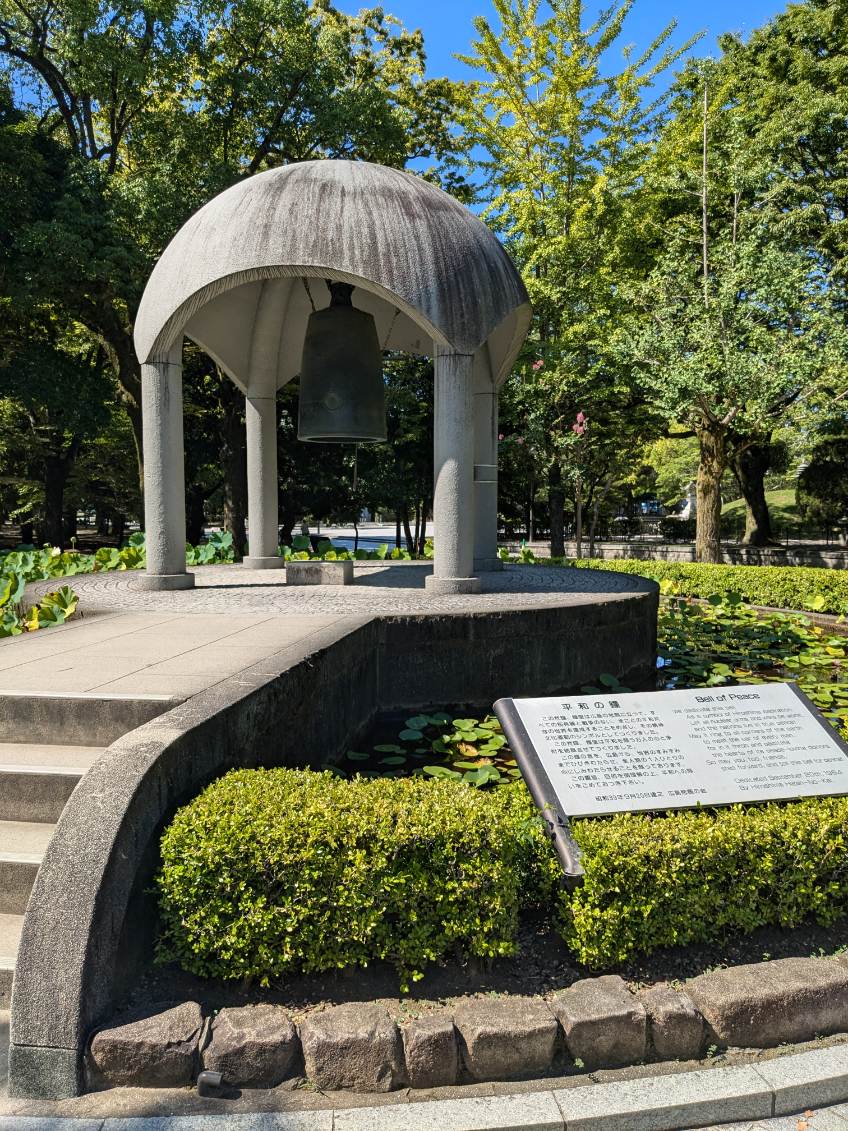
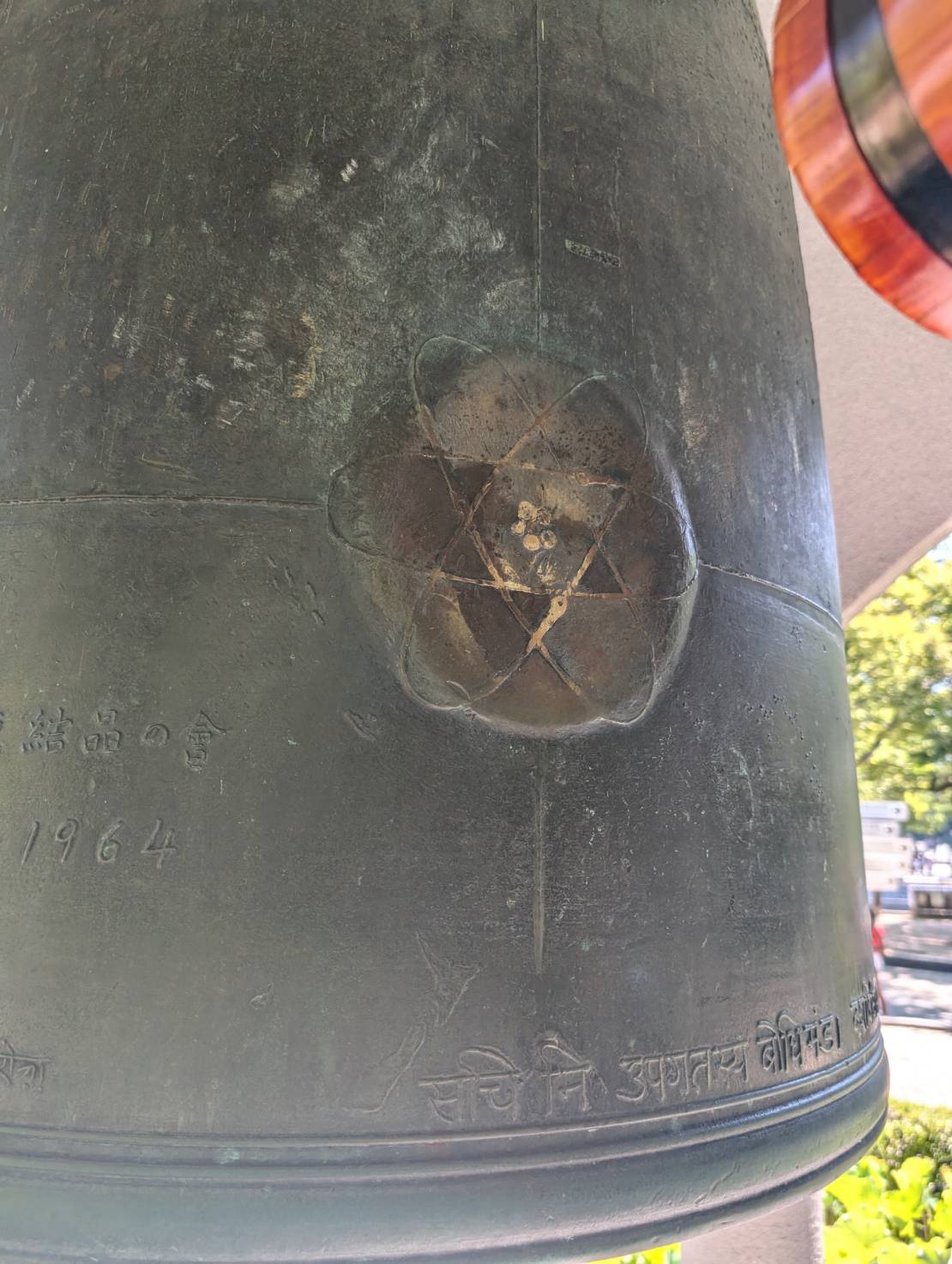
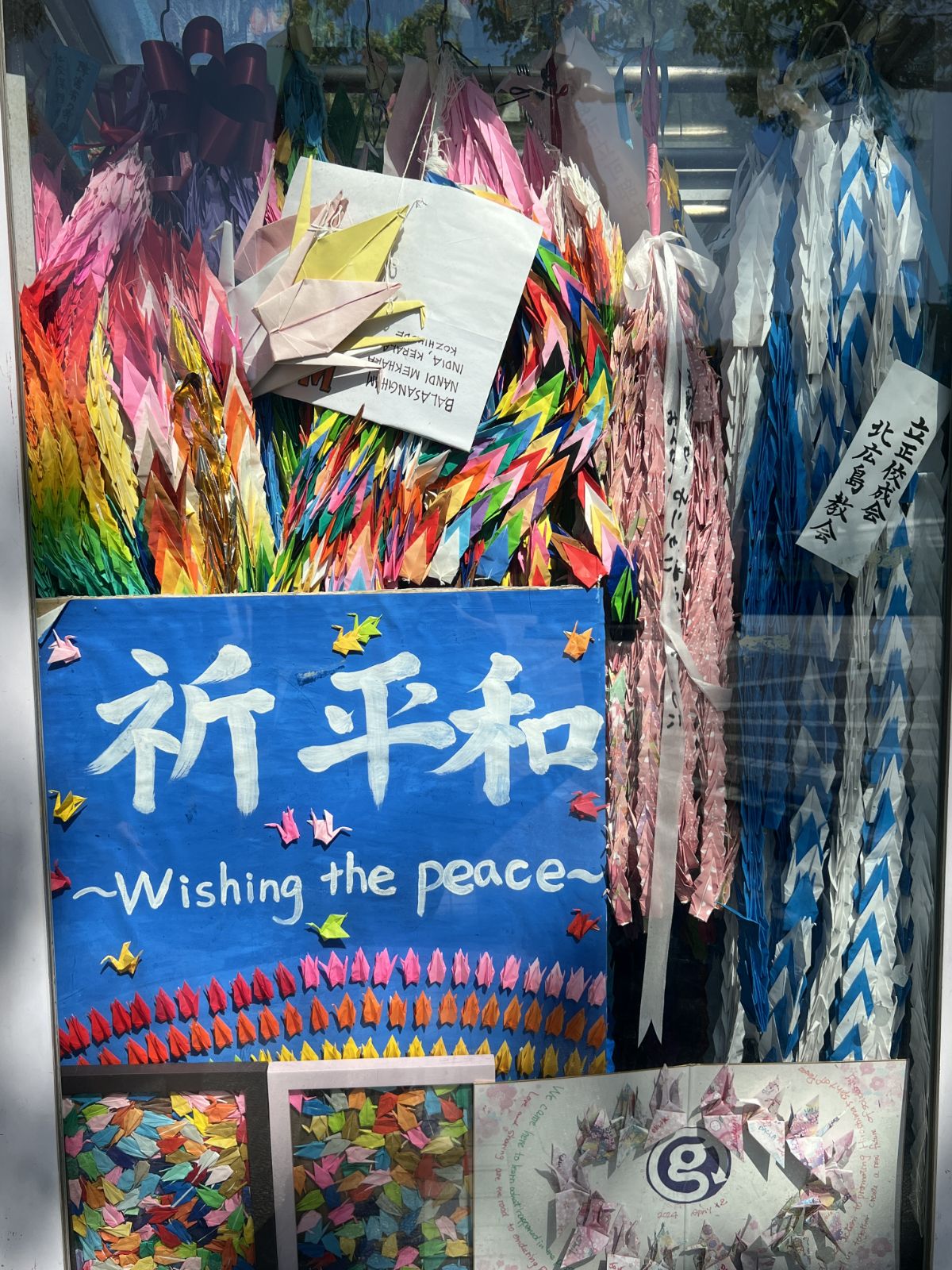
We then walked through the Peace park, Cenotaph, eternal flame, Children’s Memorial with the folded paper cranes, representing peace, Ringing the Bell of Peace, and a view of the Atomic Bomb dome before going through the museum.
We asked the ringers to submit their experience of the day if they so chose to. The reactions are thoughts on their experience they learned today, understanding that for some of them, this is their first introduction to the history and for others they can put this event into context of the war. The question came up as why did we drop a second bomb in Nagasaki if we knew all the effects. A good reminder to us all that information of what was happening on the ground was not instantaneous, (no cell phones, tik tok or instagram). So all of the effects were not known at the time. Lessons to be learned, questions to be asked and to ponder over by our ringers.
Sasha: My heart feels heavy looking back on visiting the Hiroshima park. As much as I knew about the destruction and loss that the Japanese people faced, I felt that new snippets of information opened my eyes to the horrors of war, poverty, human suffering and the extent that human beings can hurt other human beings. Instead of viewing this event as a politically motivated decision, Eiko beautifully said that this isn’t about countries or who you are but about how people can make other people suffer. This resonated with me deeply and made me recognize that genuine empathy is essential to weaving the broken fabric of society. I cried for the people, children, healthcare workers, civilians, mothers, fathers, grandparents, impoverished and much more as I felt the weight of their suffering. A quote that hit me extremely hard was,
“Dear little child, embrace in your mother’s love, play the gold trumpet…… No matter what our future will be like.” – Shinpei Kusano, August 1978
(Featured on the Prayer for Peace Memorial Statue)
Let’s all take a moment to think of our loved ones no matter where they are and keep them forever in our hearts and minds because the every moment of time with them is precious.
George: Throughout the course of the tour I was consistently surprised how blunt they were with the effects and the pure visuals of damage shown. It was like showing me the exact consequences for a decision that should never be made again, while still showing me a path of good and redemption at the end with new life.
Sarah: Today was sobering. It reminded me of 9/11, magnified by 50. The memorial and subsequent museum serve to teach us a lesson to never forget, and work to never witness an event like that again. (In war), the only way to win is to not play.
Carolyn: This was my third time visiting the Hiroshima memorial and I was struck by the fact that I was just as emotional as the first time. Maybe because I have kids myself I was especially moved by both the stories of children and by schoolchildren all over Japan sending folded paper cranes to the memorial as messages of peace. I found myself wondering about the political leadership that decided to drop the bombs. Did they have ANY idea how awful the impact would be and that it would continue for decades? I’m grateful to have been able to visit with my family.
Julia: As we were walking around the memorials and the museum this morning, it was hard not to feel guilty for all of the destruction and devastation that were very evident. This morning Eiko told us that we shouldn’t feel that way, that it was something our ancestors chose to do and that we had nothing to do with it, but still it was difficult. I could plainly see pictures of people in distress and remnants of their clothing preserved. But that was the whole point of the museum and structures outside of it. To remind us how much damage a single decision can cause. To say that something like that should never happen again and no one should have to go through that again.
Jordan: It was amazing to be able to visit the Hiroshima Peace Museum, Memorial, and Park; and I’m thankful that our choir had the chance to stay in this beautiful city. The museum was a challenging experience. It shared experiences of survivors, those who sadly passed away, and the city itself before and after the destruction. It was heartbreaking to see women, children, and families wiped out by this horrific experience. Humans can hurt other humans in such abhorrent manners, something underscored by the pictures, videos, and items present. I do not believe there’s a lesson stronger than we cannot allow history to repeat itself. Many countries still possess nuclear weapons and many still have not signed treaties to curb their existence. Without these treaties, the threat of nuclear war or nuclear utilization is still a possibility. It is evident that we must not just see Hiroshima, but work to truly understand the impact and ensure that another nuclear explosion does not occur. As we’ve been in this city, one phrase has come up over and over again: “No more Hiroshimas”. You can see it on pamphlets, on pins, on T-Shirts — even shouted in the street. On the surface, it implies no more nuclear warfare, no more bombings, no more destruction of entire cities. But at it’s core, it means no more violence, genocide, brutality. It emphasizes peace, love, kindness. It means that little children can grow up with hope for their future. It means that people can live long, happy, and healthy lives. No More Hiroshimas is a call for evaluation, adjustment, and reconciliation. No matter how much sense the bomb made before it was dropped, it made very little sense after. And it is in that lack of understanding that we must memorize and memorialize to ensure that no humans ever have to endure that level of tragedy again.
Judith: To be in a place where so many lives were forever changed was overwhelming. We cannot accomplish peace on a global level. Peace is a verb so I challenge you today and everyday: 2B KIND, 2B GENEROUS and 2 INCLUDE everyone as we strive for PEACE.
Brian: As we depart from Hiroshima are my mind is filled with sadness and hope.
Sadness as images were introduced to us that are not published or spoken of in school textbooks and lectures. Today, I fully recognize that history is written by perspectives, not full truths.
After leaving the museum, my thoughts revolved around today’s youth and the power they will assume in this world. The power of peace and that of new technologies created to keep peace.
I am filled with hope for the next generation and that they embrace their role of learning from the past, to ensure a world of peace.
Sadness is understanding the devastation of war. However, Hope is the keeper of world peace.
Anonymous: Today we visited the peace memorial museum in Hiroshima. To read and see what humans are capable of doing to each other was gut-wrenching and I will never forget it. Outside the museum, the river and peace park were beautiful. My favorite was the children’s peace monument with a statue of the little girl holding a crane above her head.
Ruth: How sad and disappointed God must have been that we resorted to such destruction. Killing, maiming, and destroying innocent people as they went about their daily lives. Creating a cascading effect that continues to this day. May we all be instruments of peace, never forgetting what happens when we let hatred rule us. Let us walk this earth being good stewards and being kind to all Gods people regardless of differences. We must continue to work hard finding ways to connect and spread love and peace.
Aria: When I saw everything my country had done, it made me realize how horrible it had been for all those people to have died and been poisoned by the radioactive waves. I was angry that one of our presidents had decided that this was the right choice for either of our countries, even if we had been at war against each other at the time. it was a horrible thing to do and I hope that no one will make a similar decision again.
Susan: The consequences of this act during war will always be remembered but there is still war in the world right now with incredible atrocities- all the more reason for world peace.
Dante: After seeing what happened to the Japanese people after they got hit by the bomb, I could tell how bad it must have been for them if I felt this way while just seeing photos of injuries. These people were a bustling city, and then there were 125,000 people dead and more poisoned by the radiation. All of the buildings except two or three were completely demolished, making it look like all the walls collapsed. I still want to know why the American government did this, and why they thought this was the thing to do. The A-bombing of Hiroshima was a terrible mistake that the United States government had made, and think we should immediately stop nuclear weapons and attacks so this never happens again.
 KCR/ERI Japan Tour 2024